
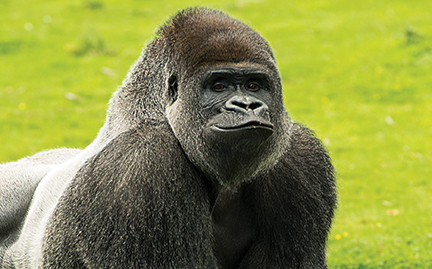
GORILLA
Gorillas are ground-dwelling, predominantly herbivorous apes that inhabit the forest of central Sub-Saharan Africa. The genus Gorilla is divided into two species: the eastern gorillas and the western gorillas (both critically endangered), and either four or five subspecies. They are the largest living primates. The DNA of gorillas is highly similar to that of humans, from 95 to 99% depending on what is included, and they are the next closest living relatives to humans after the chimpanzees and bonobos.
Gorillas move around by knuckle-walking, although they sometimes walk bipedally for short distances while carrying food or in defensive situations,[15] and some mountain gorillas use other parts of their hand to aid locomotion (studies of 77 mountain gorillas published in 2018 showed 61% only used knuckle walking, but the remainder used knuckle walking plus other parts of their hand—fist walking in ways that do not use the knuckles, using the backs of their hand, and using their palms).[16] There is individual variation in the frequency and ease with which gorillas walk upright; certain gorillas at Philadelphia Zoo and London Zoo have been observed walking upright more frequently and for longer distances than normal, with one gorilla at the Philadelphia Zoo often doing so to avoid getting mud on his hands.[17] Wild male gorillas weigh 136 to 227 kg (300 to 500 lb), while adult females weigh 68–113 kg (150–250 lb)
A gorilla's day is divided between rest periods and travel or feeding periods. Diets differ between and within species. Mountain gorillas mostly eat foliage, such as leaves, stems, pith, and shoots, while fruit makes up a very small part of their diets.
WHERE WILL YOU FIND THEM
You will find the gorillas at pen E23, right next to the monkey trail.